
THE OLD SIGN PHILOSOPHER, THOUGHT FOR THE DAY!
I EXERCISE..............BY PUSHING MY LUCK
Saturday, March 18, 2006


Thursday, March 16, 2006
GREENSCAPE GARDENS TOP 2006 PERENNIAL PICKS
1. Hemerocallis 'Stella de Oro'
2. Hemerocallis 'Happy Returns'
3. Coreopsis v. 'Moonbeam'
4. Hosta 'Francee'
5. Artemisia s. 'Silver Mound'
6. Gaillardia 'Fanfare' PP15892
7. Salvia n. 'May Night'
8. Hosta 'Sum and Substance'
9. Sedum 'Autumn Joy'
10. Perovskia atriplicifolia
11. Hemerocallis 'Stella de Oro'
12. Hemerocallis 'Happy Returns'
13. Coreopsis v. 'Moonbeam'
14. Hosta 'Francee'
15. Artemisia s. 'Silver Mound'
16. Gaillardia 'Fanfare' PP15892
17. Salvia n. 'May Night'
18. Hosta 'Sum and Substance'
19. Sedum 'Autumn Joy'
20. Perovskia atriplicifolia
We have over 20,000 Greenscape Grown Perennials growing in our five greenhouses.
1. Hemerocallis 'Stella de Oro'
2. Hemerocallis 'Happy Returns'
3. Coreopsis v. 'Moonbeam'
4. Hosta 'Francee'
5. Artemisia s. 'Silver Mound'
6. Gaillardia 'Fanfare' PP15892
7. Salvia n. 'May Night'
8. Hosta 'Sum and Substance'
9. Sedum 'Autumn Joy'
10. Perovskia atriplicifolia
11. Hemerocallis 'Stella de Oro'
12. Hemerocallis 'Happy Returns'
13. Coreopsis v. 'Moonbeam'
14. Hosta 'Francee'
15. Artemisia s. 'Silver Mound'
16. Gaillardia 'Fanfare' PP15892
17. Salvia n. 'May Night'
18. Hosta 'Sum and Substance'
19. Sedum 'Autumn Joy'
20. Perovskia atriplicifolia
We have over 20,000 Greenscape Grown Perennials growing in our five greenhouses.
IMPROVE THE SOIL FOR MAXIMUM RESULTS
A healthy, flourishing garden begins with healthy soil. By learning as much as you can about your soil, you will be better able to match plants to your conditions. Missouri Botantical Gardens, University of Missouri Extension Service and even OK Hatchery in Kirkwood can test your soil. The test will reveal the composition of your soil (whether it’s predominantly clay, loam or sand), the nutrient levels in your soil, and the soil’s pH (its acidity or alkalinity).
You can also do a home test to determine whether your soil is clay, loam or sand. Put a handful of garden soil in a litre jar, fill it with water, shake, and then leave it to settle for a day. Sand will settle to the bottom, silt will be the next layer, with clay on top. (Organic matter will float on the water’s surface.) Compare the percentage of each layer to determine whether you’ve got loam (20% clay, 40% silt, 40% sand), clay (60% clay, 30% silt, 10% sand), or sand (5% clay, 10% silt, 85% sand).
A laboratory soil test will tell you whether your soil’s pH is acidic, neutral or alkaline--which will help you determine what plants will do best in your conditions.
To determine the drainage capacity of your soil, dig a hole 1 foot deep and 1 foot wide. Fill it with water, let it drain completely, then fill again until the soil is saturated. Depending on how long it takes for this last batch to drain, you’ve either got adequate drainage (less than 2 hours), or poor drainage (more than 2 hours).
Whatever your soil type, pH, drainage and nutrient levels, you can improve the health of your soil by adding compost. Dig in lots of compost when first preparing your garden bed for planting. In already established gardens, add a 3-inch layer of compost around your plants in spring, summer or fall.
Additional information about improving your soil can be found at our website.
Great gardens ONLY happen when an improved soil foundation has been installed. At Greenscape Gardens we are constantly informing the customer to spend additional monies on improving the soil and less on the plant material. We are in the business to sell plants but plants only grow and prosper when they are given the proper incentives to grow........GOOD SOIL.
A healthy, flourishing garden begins with healthy soil. By learning as much as you can about your soil, you will be better able to match plants to your conditions. Missouri Botantical Gardens, University of Missouri Extension Service and even OK Hatchery in Kirkwood can test your soil. The test will reveal the composition of your soil (whether it’s predominantly clay, loam or sand), the nutrient levels in your soil, and the soil’s pH (its acidity or alkalinity).
You can also do a home test to determine whether your soil is clay, loam or sand. Put a handful of garden soil in a litre jar, fill it with water, shake, and then leave it to settle for a day. Sand will settle to the bottom, silt will be the next layer, with clay on top. (Organic matter will float on the water’s surface.) Compare the percentage of each layer to determine whether you’ve got loam (20% clay, 40% silt, 40% sand), clay (60% clay, 30% silt, 10% sand), or sand (5% clay, 10% silt, 85% sand).
A laboratory soil test will tell you whether your soil’s pH is acidic, neutral or alkaline--which will help you determine what plants will do best in your conditions.
To determine the drainage capacity of your soil, dig a hole 1 foot deep and 1 foot wide. Fill it with water, let it drain completely, then fill again until the soil is saturated. Depending on how long it takes for this last batch to drain, you’ve either got adequate drainage (less than 2 hours), or poor drainage (more than 2 hours).
Whatever your soil type, pH, drainage and nutrient levels, you can improve the health of your soil by adding compost. Dig in lots of compost when first preparing your garden bed for planting. In already established gardens, add a 3-inch layer of compost around your plants in spring, summer or fall.
Additional information about improving your soil can be found at our website.
Great gardens ONLY happen when an improved soil foundation has been installed. At Greenscape Gardens we are constantly informing the customer to spend additional monies on improving the soil and less on the plant material. We are in the business to sell plants but plants only grow and prosper when they are given the proper incentives to grow........GOOD SOIL.
Tuesday, March 14, 2006
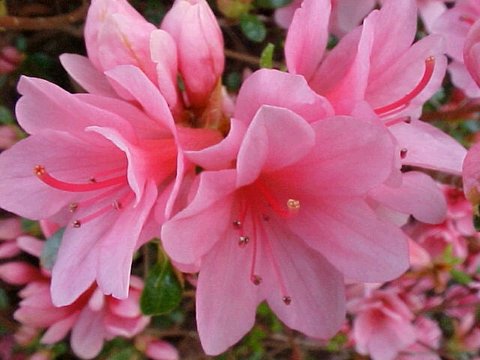
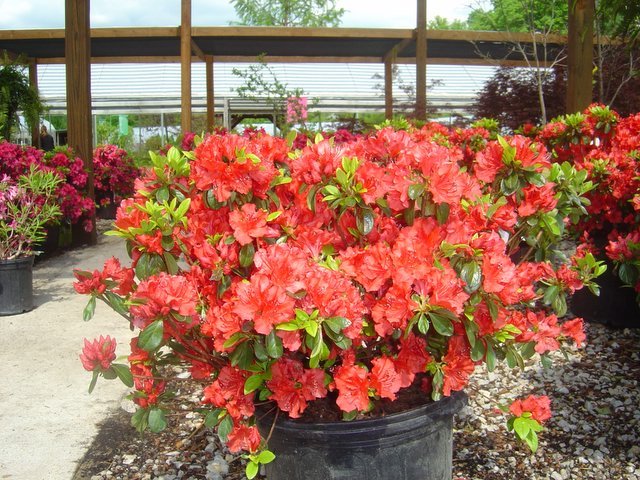 ONE OF THE MOST BEAUTIFUL FLOWERING SHRUBS IN NATURE IS DEFINITELY THE AZALEA. FOR THE LARGEST SELECTION OF AZALEAS IN THE MIDWEST, GREENSCAPE GARDENS. THE SHADEHOUSE IS BRIMMING WITH 10 DIFFERENT VARIETIES OF AZALEAS. PLUS A GREAT SELECTION OF RHODIES.
 BUY THEM NOW..........
WOULDN'T YOU PREFER THE FLOWERS IN YOUR GARDEN THAN GREENSCAPE GARDENS.

WELCOME WILDLIFE TO THE GARDEN
With spring quickly approaching, we should consider welcoming wildlife into our gardens. Birds, butterflies and pollinating insects all bring life to the garden and pleasure to the gardener. Hang out the welcome mat by creating habitat that meets the needs of wild creatures.
The best way to attract wildlife is to plant a diversity of species: trees, shrubs and perennials. These different layers in the garden will provide a variety of habitats for the specific needs of various creatures.
Include varieties of flowers that bloom throughout the growing season, from spring to fall, ensuring a long-lasting food source for nectar-loving creatures such as butterflies. Leave seedpods on perennial plants over the winter to provide an important food source for birds. If you have the space, consider planting both deciduous and evergreen trees, which will provide year-round habitat for birds. Choose shrubs that produce berries for birds.
Consider replacing a portion of the lawn with either a flowerbed or a low-growing groundcover. Lawns provide little in the way of wildlife habitat.
Consider adding a water feature to your garden. This is one of the best ways to create wildlife habitat. Water features can be as simple as a bowl of water left on the ground in an open area or, better yet, it can be a bird bath. A pond requires more work (both in planning and in maintenance), but has enormous wildlife benefits.
To attract wildlife, it’s important to garden organically. Synthetic chemicals kill butterflies and beneficial insects. Keep a list of the creatures that visit your garden habitat, and share the news of sightings with others in your neighbourhood. It may inspire them to create wildlife habitat, too.
With spring quickly approaching, we should consider welcoming wildlife into our gardens. Birds, butterflies and pollinating insects all bring life to the garden and pleasure to the gardener. Hang out the welcome mat by creating habitat that meets the needs of wild creatures.
The best way to attract wildlife is to plant a diversity of species: trees, shrubs and perennials. These different layers in the garden will provide a variety of habitats for the specific needs of various creatures.
Include varieties of flowers that bloom throughout the growing season, from spring to fall, ensuring a long-lasting food source for nectar-loving creatures such as butterflies. Leave seedpods on perennial plants over the winter to provide an important food source for birds. If you have the space, consider planting both deciduous and evergreen trees, which will provide year-round habitat for birds. Choose shrubs that produce berries for birds.
Consider replacing a portion of the lawn with either a flowerbed or a low-growing groundcover. Lawns provide little in the way of wildlife habitat.
Consider adding a water feature to your garden. This is one of the best ways to create wildlife habitat. Water features can be as simple as a bowl of water left on the ground in an open area or, better yet, it can be a bird bath. A pond requires more work (both in planning and in maintenance), but has enormous wildlife benefits.
To attract wildlife, it’s important to garden organically. Synthetic chemicals kill butterflies and beneficial insects. Keep a list of the creatures that visit your garden habitat, and share the news of sightings with others in your neighbourhood. It may inspire them to create wildlife habitat, too.
Monday, March 13, 2006
Saturday, March 11, 2006
Cool season grasses are starting to wake up and now is the time to start caring for your lawn care needs! The first application of crabgrass control should be applied between now and the second week of April.
If your lawn is in serious need of seeding---DO NOT APPLY CRABGRASS CONTROL--until the new seedlings are at least 1-2 inches of height. The crabgrass control agent will reduce, if not eliminate seed germination.
Greenscape Gardens highly recommends a second application of crabgrass control six weeks after the first application. We highly recommend applying (a crabgrass only product) if a serious crabgrass infestation occurred last year. The areas which should be reapplied include any sunny areas especially along sidewalks and driveway areas where the sun will warm up the area more.
We don't recommend applying pre-emergent control to zoysia and bermuda grass.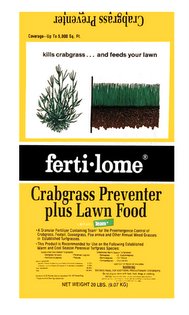
If your lawn is in serious need of seeding---DO NOT APPLY CRABGRASS CONTROL--until the new seedlings are at least 1-2 inches of height. The crabgrass control agent will reduce, if not eliminate seed germination.
Greenscape Gardens highly recommends a second application of crabgrass control six weeks after the first application. We highly recommend applying (a crabgrass only product) if a serious crabgrass infestation occurred last year. The areas which should be reapplied include any sunny areas especially along sidewalks and driveway areas where the sun will warm up the area more.
We don't recommend applying pre-emergent control to zoysia and bermuda grass.

GROW NATIVE
Native plants are species that existed in an area prior to European settlement. They’ve developed over millennia and are adapted to local conditions. The big advantage for the green gardener is that native plants tend to be lower maintenance, requiring little in the way of supplementary watering and no synthetic chemicals.
Learn about the native plants that grow in your area, and learn about what type of habitat they prefer in the wild (for example, woodland, meadow, prairie, wetland).
Visit a specialty native plant nursery to find out what native plants are commercially available in your area. (Never dig plants from the wild.) Compare the conditions found in your garden (shade or sun, dry or moist, etc.) to the conditions required by a variety of native plants that you’re interested in growing and that are commercially available in your area.
The native plants will thrive in your garden when you match the plants to the conditions-woodland plants for shade, sun-loving plants for meadows and prairies, wetland plants for moist areas. Water young transplants for the first six weeks after planting, but after that, they should thrive without supplementary watering.
Design your native plant garden in whatever style appeals to you. Consider the placement of your native plants, to reduce any infractions from local ordinances.
Friday, March 10, 2006
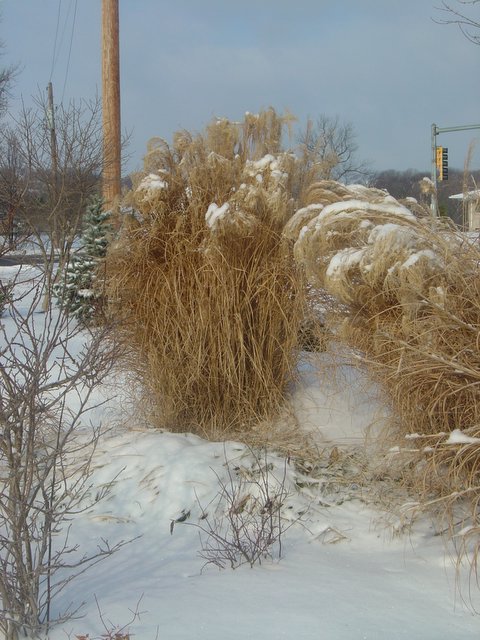
GRASS GAS......ALTERNATIVE FUEL
“Forty percent of U.S. energy is used as electricity,” doctoral students Emily A. Heaton and Frank G. Dohleman, “And the easiest way to get electricity is using a solid fuel such as coal. However, dry, leafless Miscanthus stems can be used as a solid fuel.” The cool-weather-friendly perennial grass, sometimes referred to as elephant grass or E-grass, grows from an underground stem-like organ called a rhizome.
Burning Miscanthus produces only as much carbon dioxide as it removes from the air as it grows, said Heaton, who is seeking a doctorate in crop sciences. That balance means there is no net effect on atmospheric carbon dioxide levels, which is not the case with fossil fuels, she said. Miscanthus also is a very efficient fuel, because the energy ratio of input to output is less than 0.2. In contrast, the ratios exceed 0.8 for ethanol and biodiesel from canola, which are other plant-derived energy sources.
Besides being a clean, efficient and renewable fuel source, Miscanthus also is remarkably easy to grow. Other varieties of Miscanthus have been grown successfully in Indiana, Michigan and Ohio. However, the giant Miscanthus being grown by the Illinois researchers has the greatest potential as a fuel source because of its high yields and because it is sterile and cannot become a weed. “Miscanthus sacchariflorus and some of the other fertile Miscanthus species can be quite invasive.” The next step is to demonstrate how Miscanthus goes from a plant to a power source. Existing U.S. power plants could be modified to use Miscanthus for fuel as in Europe, he said. Long collaborates with researchers at the Institute of Genomic Biology to study whether Miscanthus could be converted to alcohol, which could be used as fuel. Source: Science Daily.
“Forty percent of U.S. energy is used as electricity,” doctoral students Emily A. Heaton and Frank G. Dohleman, “And the easiest way to get electricity is using a solid fuel such as coal. However, dry, leafless Miscanthus stems can be used as a solid fuel.” The cool-weather-friendly perennial grass, sometimes referred to as elephant grass or E-grass, grows from an underground stem-like organ called a rhizome.
Burning Miscanthus produces only as much carbon dioxide as it removes from the air as it grows, said Heaton, who is seeking a doctorate in crop sciences. That balance means there is no net effect on atmospheric carbon dioxide levels, which is not the case with fossil fuels, she said. Miscanthus also is a very efficient fuel, because the energy ratio of input to output is less than 0.2. In contrast, the ratios exceed 0.8 for ethanol and biodiesel from canola, which are other plant-derived energy sources.
Besides being a clean, efficient and renewable fuel source, Miscanthus also is remarkably easy to grow. Other varieties of Miscanthus have been grown successfully in Indiana, Michigan and Ohio. However, the giant Miscanthus being grown by the Illinois researchers has the greatest potential as a fuel source because of its high yields and because it is sterile and cannot become a weed. “Miscanthus sacchariflorus and some of the other fertile Miscanthus species can be quite invasive.” The next step is to demonstrate how Miscanthus goes from a plant to a power source. Existing U.S. power plants could be modified to use Miscanthus for fuel as in Europe, he said. Long collaborates with researchers at the Institute of Genomic Biology to study whether Miscanthus could be converted to alcohol, which could be used as fuel. Source: Science Daily.
PLANTS OF MERIT PROGRAM ASSISTS HOME GARDENING SUCCESS
(ST. LOUIS): Gardeners choosing plants for their gardens this year should first consider the Missouri Botanical Garden's dependable, recommended "Plants of Merit." Fifty-five selections have been named for 2006, including several first-time additions. Each has proven to be outstanding and reliable in the lower Midwest growing region, USDA zones five and six.
Established in 1999, the Plants of Merit program has quickly become an industry model among comprehensive plant recognition programs, focused on regionally promoting ecologically responsible diversity. The program, established by the Missouri Botanical Garden's William T. Kemper Center for Home Gardening in partnership with Powell Gardens and the University of Missouri Extension, shares expert industry knowledge of annuals, perennials, trees, shrubs and vines with home gardeners. Plant selections are dependable performers yet often underutilized by home gardeners because limited information about them is available.
"With Plants of Merit, a homeowner can save both money and time," said Mary Ann Fink, program coordinator. "The program assists gardeners in creating a pretty garden or landscape that can be easily managed without chemicals and extra work."
Each year Plants of Merit sponsors - including industry professionals and associates, institutional representatives and the gardening community - present a consulting committee with a variety of plants for possible inclusion in the list. The committee compiles the final Plants of Merit selections by focusing on what makes a quality plant. Selections are considered "good neighbor plants" for being attractive, disease and pest resistant, and non-invasive, therefore promoting responsible diversity. Plants' performances are observed for two to five years, depending on category, in order to determine their reliability. Pictures, descriptions and information on growing conditions are including in the Plants of Merit resource guide. Once plants have gained mainstream recognition and appeal, they are graduated to emeritus standing.
Among several new additions to the 2006 Plants of Merit guide is Elephant ear (Xanthosoma 'Lime Zinger'), an annual with large tropical green foliage, providing a perfect contrast with ferns and hostas. It thrives in partial shade, with leaves that grow up to 30 inches in length on plants that grow between three and four feet tall.
The 2006 guide also notes several habitat plants or selections that are attractive to wildlife. Cypress vine (Ipomoea quamoclit), for example, is an annual from the morning glory family that makes a superb cover for fences and trellises, growing between four to six feet long and potentially reaching up to 10 feet long. Its tubular scarlet flowers are magnets for hummingbirds. The Seven-son flower tree, (Heptacodium miconiodies) is a small ornamental increasing in popularity for its fragrant clusters of white flowers that bloom from late August to late September. By flowering at a young age, the tree offers butterflies a reliable nectar source year after year. Flowers are followed by a showy display of purplish-red fruits, offering multiple seasons of interest.
Today, the Plants of Merit program is financially sponsored by 60 green community members, including retail nursery and garden centers. The 2006 guide can be purchased for $2 from the Kemper Center or the Garden Gate Shop of the Missouri Botanical Garden, 4344 Shaw Blvd. in St. Louis, or from any program sponsor. View the guide free of charge online at www.plantsofmerit.org.
For more information on the Plants of Merit program, including how a community or group can earn a Merit Garden Recognition, call Mary Ann Fink at (314) 577-9443.
GREENSCAPE GARDENS IS A PROUD SPONSOR OF THE PLANTS OF MERIT. IN ADDITION, WE HAVE ONE OF THE LARGEST DISPLAY GARDENS OF PLANTS OF MERIT. MANY OF THE PLANTS HAVE BEEN PLANTED FOR SEVERAL YEARS.
(ST. LOUIS): Gardeners choosing plants for their gardens this year should first consider the Missouri Botanical Garden's dependable, recommended "Plants of Merit." Fifty-five selections have been named for 2006, including several first-time additions. Each has proven to be outstanding and reliable in the lower Midwest growing region, USDA zones five and six.
Established in 1999, the Plants of Merit program has quickly become an industry model among comprehensive plant recognition programs, focused on regionally promoting ecologically responsible diversity. The program, established by the Missouri Botanical Garden's William T. Kemper Center for Home Gardening in partnership with Powell Gardens and the University of Missouri Extension, shares expert industry knowledge of annuals, perennials, trees, shrubs and vines with home gardeners. Plant selections are dependable performers yet often underutilized by home gardeners because limited information about them is available.
"With Plants of Merit, a homeowner can save both money and time," said Mary Ann Fink, program coordinator. "The program assists gardeners in creating a pretty garden or landscape that can be easily managed without chemicals and extra work."
Each year Plants of Merit sponsors - including industry professionals and associates, institutional representatives and the gardening community - present a consulting committee with a variety of plants for possible inclusion in the list. The committee compiles the final Plants of Merit selections by focusing on what makes a quality plant. Selections are considered "good neighbor plants" for being attractive, disease and pest resistant, and non-invasive, therefore promoting responsible diversity. Plants' performances are observed for two to five years, depending on category, in order to determine their reliability. Pictures, descriptions and information on growing conditions are including in the Plants of Merit resource guide. Once plants have gained mainstream recognition and appeal, they are graduated to emeritus standing.
Among several new additions to the 2006 Plants of Merit guide is Elephant ear (Xanthosoma 'Lime Zinger'), an annual with large tropical green foliage, providing a perfect contrast with ferns and hostas. It thrives in partial shade, with leaves that grow up to 30 inches in length on plants that grow between three and four feet tall.
The 2006 guide also notes several habitat plants or selections that are attractive to wildlife. Cypress vine (Ipomoea quamoclit), for example, is an annual from the morning glory family that makes a superb cover for fences and trellises, growing between four to six feet long and potentially reaching up to 10 feet long. Its tubular scarlet flowers are magnets for hummingbirds. The Seven-son flower tree, (Heptacodium miconiodies) is a small ornamental increasing in popularity for its fragrant clusters of white flowers that bloom from late August to late September. By flowering at a young age, the tree offers butterflies a reliable nectar source year after year. Flowers are followed by a showy display of purplish-red fruits, offering multiple seasons of interest.
Today, the Plants of Merit program is financially sponsored by 60 green community members, including retail nursery and garden centers. The 2006 guide can be purchased for $2 from the Kemper Center or the Garden Gate Shop of the Missouri Botanical Garden, 4344 Shaw Blvd. in St. Louis, or from any program sponsor. View the guide free of charge online at www.plantsofmerit.org.
For more information on the Plants of Merit program, including how a community or group can earn a Merit Garden Recognition, call Mary Ann Fink at (314) 577-9443.
GREENSCAPE GARDENS IS A PROUD SPONSOR OF THE PLANTS OF MERIT. IN ADDITION, WE HAVE ONE OF THE LARGEST DISPLAY GARDENS OF PLANTS OF MERIT. MANY OF THE PLANTS HAVE BEEN PLANTED FOR SEVERAL YEARS.
Thursday, March 09, 2006
One of the three tractor trailer loads of nursery stock to land at the garden center on Thursday. Greenscape Gardens has the most unique trees and shrubs in the St. Louis area. One truck was from Oregon with plants from three different growers. Another truck was from southern Illinois and the third truck was from Oklahoma. We are talking the finest quality of plant stock and the most unusual in the midwest. 

SPACING OUT ON TURFGRASS
Satellite data shows that in terms of surface area, turfgrass is the largest irrigated crop in the United States. There are three times more acres of lawn in the U.S. than irrigated corn.
The study used satellite data on impervious surfaces to estimate how much of the country is covered by bermuda-
grass, St. Augustine, fescue and other turfgrass. The study defined lawns as residential and commercial landscapes, golf courses and other turf-covered areas. Cristina Milesi of the NASA Ames Research Center’s ecological forecasting group led the study. “Even conservatively,” Milesi says, “I estimate there are three times more acres of lawns in the U.S. than irrigated corn.”
This means lawns—including residential and commercial lawns, golf courses, etc—can be considered the single largest irrigated crop in America in terms of surface area, covering about 128,000 square kilometers in all. Her next task was to figure out some of the ecological impacts of this crop of lawns Americans are cultivating.
Ecological Impact of Lawns
Recognizing that different people and businesses treat their lawns differently, she had a computer simulate the effect on the water cycle and carbon cycle of different lawn manage-
ment techniques. The variables the models tested included watering a fixed amount (including rainfall) versus watering according to weather and evaporation rates, adding different amounts of fertilizer, and leaving the clippings on the lawn after mowing or bagging them up.
Some of the results weren’t surprising, explains Milesi. The model confirmed that if people watered according to a fixed amount, about 2.5 centimeters (1 inch) per week minus rainfall, then lawns in rainier places, such as Lincoln Park, Michigan, wouldn’t need any irrigation at all, while Yuma, Arizona, would need the full 2.5 centimeters of irrigation each week.
“If people watered according to what the meteorology indicated, factoring in temperature and humidity, for example, then it would improve irrigation efficiency—use less water—in the Southeast, where humidity is high. But in the West, there is so much sun and humidity is so low that plants can evaporate a lot more than 1 inch of water a week.” In the West, if people watered according to evaporation rates, the model predicts they would need to water nearly 200 centimeters per year.
To learn more about the turfgrass study visit http://earthobservatory.nasa.gov/Study/Lawn/lawn.html
Satellite data shows that in terms of surface area, turfgrass is the largest irrigated crop in the United States. There are three times more acres of lawn in the U.S. than irrigated corn.
The study used satellite data on impervious surfaces to estimate how much of the country is covered by bermuda-
grass, St. Augustine, fescue and other turfgrass. The study defined lawns as residential and commercial landscapes, golf courses and other turf-covered areas. Cristina Milesi of the NASA Ames Research Center’s ecological forecasting group led the study. “Even conservatively,” Milesi says, “I estimate there are three times more acres of lawns in the U.S. than irrigated corn.”
This means lawns—including residential and commercial lawns, golf courses, etc—can be considered the single largest irrigated crop in America in terms of surface area, covering about 128,000 square kilometers in all. Her next task was to figure out some of the ecological impacts of this crop of lawns Americans are cultivating.
Ecological Impact of Lawns
Recognizing that different people and businesses treat their lawns differently, she had a computer simulate the effect on the water cycle and carbon cycle of different lawn manage-
ment techniques. The variables the models tested included watering a fixed amount (including rainfall) versus watering according to weather and evaporation rates, adding different amounts of fertilizer, and leaving the clippings on the lawn after mowing or bagging them up.
Some of the results weren’t surprising, explains Milesi. The model confirmed that if people watered according to a fixed amount, about 2.5 centimeters (1 inch) per week minus rainfall, then lawns in rainier places, such as Lincoln Park, Michigan, wouldn’t need any irrigation at all, while Yuma, Arizona, would need the full 2.5 centimeters of irrigation each week.
“If people watered according to what the meteorology indicated, factoring in temperature and humidity, for example, then it would improve irrigation efficiency—use less water—in the Southeast, where humidity is high. But in the West, there is so much sun and humidity is so low that plants can evaporate a lot more than 1 inch of water a week.” In the West, if people watered according to evaporation rates, the model predicts they would need to water nearly 200 centimeters per year.
To learn more about the turfgrass study visit http://earthobservatory.nasa.gov/Study/Lawn/lawn.html
Monday, March 06, 2006
Another two more truckloads of the finest nursery stock has arrived at Greenscape Gardens. A truckload of decidious trees including 4 different varieties of maples, 2 varieties of ash, magnolias, river birches and some of the nicest dogwoods you've ever seen were unloaded today. At the end of the day, a truck arrived with some unusual plants from Oregon. We still have three full tractor trailer loads of nursery stock from Oregon slated for the next couple of weeks.
The plants are really rolling in now. Let's just hope that "Mother Nature" cooperates.
The plants are really rolling in now. Let's just hope that "Mother Nature" cooperates.

Alcohol and Lawn Mowers Don’t Mix
Drinking alcoholic beverages while operating power equipment is not recommended. In 2005, a Vermont man was convicted of a DUI after driving a mower to the liquor store with a .16 blood-alcohol level.
Workplace alcohol use and impairment affects an estimated 15 percent of the U.S. workforce (19.2 million workers) according to a study published by the University at Buffalo’s Research Institute on Addictions.
Grounds maintenance occupations, it turns out, have among the highest rates of workplace alcohol use. The findings were reported in the January issue of the Journal of Studies on Alcohol (Frone, M.R. “Prevalence and Distribution of Alcohol Use and Impairment in the Workplace: A U.S. National Survey.”)
The results were obtained by telephone interviews from 2,805 employed adults.
The paper says that this is the first study of workplace alcohol use to survey a representative sample of the U.S. workforce. The broad occupation groups showing the highest rates of workplace alcohol use and impairment were the management occupations, sales occupations, arts/entertainment/sports/media occupations, food preparation and serving occupations, and building and grounds maintenance occupations. The study was funded by the National Institute on Alcohol.
Drinking alcoholic beverages while operating power equipment is not recommended. In 2005, a Vermont man was convicted of a DUI after driving a mower to the liquor store with a .16 blood-alcohol level.
Workplace alcohol use and impairment affects an estimated 15 percent of the U.S. workforce (19.2 million workers) according to a study published by the University at Buffalo’s Research Institute on Addictions.
Grounds maintenance occupations, it turns out, have among the highest rates of workplace alcohol use. The findings were reported in the January issue of the Journal of Studies on Alcohol (Frone, M.R. “Prevalence and Distribution of Alcohol Use and Impairment in the Workplace: A U.S. National Survey.”)
The results were obtained by telephone interviews from 2,805 employed adults.
The paper says that this is the first study of workplace alcohol use to survey a representative sample of the U.S. workforce. The broad occupation groups showing the highest rates of workplace alcohol use and impairment were the management occupations, sales occupations, arts/entertainment/sports/media occupations, food preparation and serving occupations, and building and grounds maintenance occupations. The study was funded by the National Institute on Alcohol.
Subscribe to:
Posts (Atom)

 Posts
Posts

