Saturday, February 27, 2010

THE OLD SIGN PHILOSOPHER

WHAT AM I?

Posted by Picasa
THE OLD SIGN PHILOSOPHER

ONLY 21 DAYS UNTIL SPRING.
THIS WINTER IS THE LONGEST IN HISTORY!

Posted by Picasa
THE OLD SIGN PHILOSOPHER

BORROW MONEY FROM PESSIMISTS,
THEY DON'T EXPECT IT BACK.

GREENSCAPE GARDENS RAILROAD

Posted by Picasa
THE OLD SIGN PHILOSOPHER

HAVE YOU EVER NOTICED THAT EVERYONE'S LAWN
LOOKS GOOD WITH SNOW!

THE GREENSCAPE GARDENS RAILROAD

Posted by Picasa
THE OLD SIGN PHILOSOPHER

DAN HEIMS (TERRA NOVA)
JENNIFER SCHAMBER (GREENSCAPE GARDENS)

TERRA NOVA IS A GROWER OF PREMIUM PERENNIALS
DAN VISITED GREENSCAPE GARDENS IN 2007.

Posted by Picasa

Wednesday, February 24, 2010

GREENSCAPE GARDENS
Ten Reasons To Plant A Tree
.
1. Trees conserve energy in the summer, and thereby save you money. Properly planted trees can cut your air-conditioning costs by 15-35%
.
2. Trees help clean the air. Trees produce the oxygen we breathe, and remove air pollution by lowering air temperature, through respiration, and by retaining particulates.
.
3. Trees bring songbirds close by. Birdsong will fill the air as trees provide nesting sites, food, and cover for countless species.
.
4. Trees around your home can increase its value by up to 15% or more. Studies of comparable houses with and without trees place a markedly higher value on those whose yards are sheltered by trees.
.
5. Trees help clean our rivers and streams. Trees hold the soil in place and reduce polluted runoff into our waterways.
.
6. Trees conserve energy in the winter. Trees can slow cold winter winds, and can cut your heating costs 10-20%.
.
7. Trees fight global warming. They remove carbon dioxide from the atmosphere, the major contributor to the threat of global warming. Trees planted near our homes and in our communities moderate temperatures and reduce the need for air conditioning and heating produced by burning fossil fuels, a major source of excess atmospheric carbon dioxide.
.
8. Trees make your home and your neighborhood, more beautiful. Trees mark the changing of the seasons, and add grace and seasonal color. Trees make a house feel like a home.
.
9. Trees are fun! Planting and caring for trees can be a great family and community building activity.
.
10. The most important reason is: We have one of the greatest selections of outstanding trees in the St. Louis area.
THE OLD SIGN PHILOSOPHER

COMING SOON
SPRING COLOR

Posted by Picasa
THE OLD SIGN PHILOSOPHER

WE HAVE ONLY ONE PERSON TO BLAME,
AND THAT'S EACH OTHER.

THE NATURAL BEAUTY OF NATURE
Posted by Picasa
THE OLD SIGN PHILOSOPHER

WALK LIGHTLY IN THE SPRING,
MOTHER NATURE IS PREGNANT.
AND THE BISON ARE BIG.

GRAND TETONS

Posted by Picasa

Tuesday, February 23, 2010

A LESSON OF LIFE
OR
The Mayonnaise Jar & 2 cups of coffee
.
When things in your life seem almost too much to handle, when 24 hours in a day are not enough, remember the mayonnaise jar and the 2 cups of coffee.
.
A professor stood before his philosophy class and had several items in front of him. When the class began, he wordlessly picked up a very large and empty mayonnaise jar and proceeded to fill it with golf balls.
.
He then asked the students if the jar was full. They agreed that it was.
.
The professor then picked up a box of pebbles and poured them into the jar. He shook the jar lightly. The pebbles rolled into the open areas between the golf balls. He then asked the students again if the jar was full. They agreed it was.
.
The professor next picked up a box of sand and poured it into the jar. Of course, the sand filled up everything else. He asked once more if the jar was full. The students responded with an unanimous "yes."
.
The professor then produced two cups of coffee from under the table and poured the entire contents into the jar effectively filling the empty space between the sand. The students laughed, "Now," said the professor as the laughter subsided, "I want you to recognize that this jar represents your life. The golf balls are the important things--God, your family, your children, your health, your friends and your favorite passions--and if everything else was lost and only they remained, your life would still be full.
.
The pebbles are the other things that matter like your job, your house and your car.
.
The sand is everything else--the small stuff. "If you put the sand into the jar first," he continued, "there is no room for the pebbles or the golf balls. The same goes for life. If you spend all your time and energy on the small stuff you will never have room for the things that are important to you. "Pay attention to the things that are critical to your happiness. Play with your children. Take time to get medical checkups. Take your spouse out to dinner. Play another 18. There will always be time to clean the house and fix the disposal. Take care of the golf balls first--the things that really matter. Set your priorities. The rest is just sand.”
.
One of the students raised her hand and inquired what the coffee represented. The professor smiled. "I'm glad you asked. It just goes to show you that no matter how full your life may seem, there's always room for a couple of cups of coffee with a friend."
THE OLD SIGN PHILOSOPHER

THE HARDEST THING TO UNDERSTAND IN THE WORLD
IS THE INCOME TAX.

Posted by Picasa
THE OLD SIGN PHILOSOPHER

MEN ARE FROM EARTH,
WOMEN ARE FROM EARTH,
DEAL WITH IT.

Posted by Picasa

Monday, February 22, 2010

GREENSCAPE GARDENS LAWN TIPS
New Herbicide Targets Wild Violets
.
Wild violets can quickly take over lawns in the St. Louis area. Give this weed an inch and it'll take a yard. A relatively new herbicide can be used on turf to control wild violets and many other hard-to-control broadleaf weeds. It’s called carfentrazone. This material is rain-fast in three hours, and you can reseed the treated area two weeks after application. For violet control, it needs to be used in early to mid-April, when the violets are just starting to grow.
.
Sold as SpeedZone, it has been used in the professional lawn-care industry with exceptional results. It’s now available at Greenscape Gardens. We used the product at the garden center last year and had great control on some hard to control wild violets. “While low levels of chemical residue may occur in surface and groundwater, the risk to non-target plants or animals is low,” the EPA fact sheet on the substance states. “Carfentrazone is considered to be practically non-toxic to birds. The chemical is moderately toxic to aquatic animals.
.
Remember the best time to apply SpeedZone is when the wild violets first reappear in early spring. One application normally will eradicate these unwanted weeds. It is heat sensitive. We highly recommend its usuage in early spring before temperatures reach into the 80's. Finally a herbicide that eliminates violets.
.
For more information concerning the care and maintenance of cool season lawns go to Greenscape Gardens Lawn Care.
THE OLD SIGN PHILOSOPHER

ONE YEAR AGO TODAY
WE ALL MISS YOU!

Posted by Picasa
THE OLD SIGN PHILOSOPHER

THE EARLY BID GETS THE WORM,
BUT THE SECOND MOUSE GETS THE CHEEZE.

Posted by Picasa

Sunday, February 21, 2010

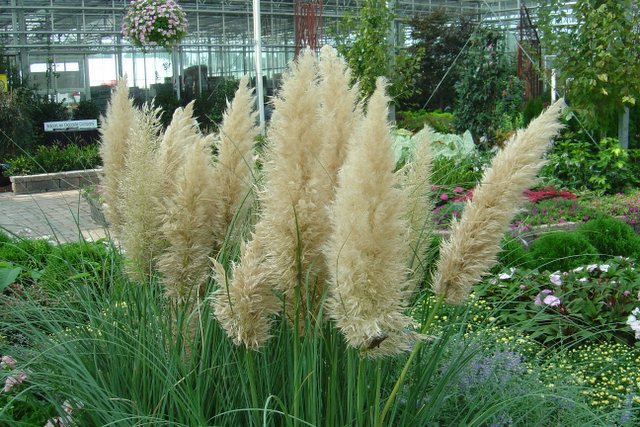
GREENSCAPE GARDENS ORNAMENTAL GRASS

Once again the rave in the St. Louis gardening scene...........Ornamental grasses. We are growing more than 20 different varieties of perennial ornamental grasses. In another couple of weeks (normally St. Patrick's weekend) I highly recommend cutting back the spent shoots from last year. Cut the dead stalks down to within 3-4 inches from the soil. This will make the plant much more attractive for this year. One of the tricks that we use at the garden center is to put black plastic over the stubs of the plants and secure the plastic with bricks in the corners. Wait 10-14 days and take off the plastic. This will warm up the soil around the grasses and they will grow much quicker in the early spring.
THE OLD SIGN PHILOSOPHER

A BALANCED DIET IS A COOKIE IN EACH HAND
OR ONE SMALL DESSERT

Posted by Picasa
THE OLD SIGN PHILOSOPHER

LIFE IN A VACUUM SUCKS
SO DOES ALL THIS SNOW

GREENSCAPE GARDENS CHICKEN RANCH

Posted by Picasa

Saturday, February 20, 2010

GREENSCAPE GARDENS TREE INFORMATION
Chestnut Blight
.
Prior to the chestnut blight, one in four hardwood trees in Pennsylvania was a chestnut, according to the American Chestnut Foundation. Mature chestnuts grew to 100 feet tall, and many specimens reached 8-10 feet in diameter. Wildlife including birds, bears, squirrels and deer depend on the tree's abundant crop of nutritious nuts.
.
Tree expert Tim Phelps is confident that blight-resistant chestnuts are not only possible, but almost here. Blight wiped out virtually all American chestnut trees in North America after it showed up in New York in 1904. Now, seven decades of crossing blight-resistant Chinese chestnut trees with American chestnut trees, and then repeatedly back-crossing the progeny with other American chestnuts, has created 200 hybrids. The trees are now being tested in the Arboretum at Penn State with inoculations of the fungus that causes chestnut blight—with promising results.
.
Phelps, of the College of Agricultural Sciences and president of the Pennsylvania Chapter of the American Chestnut Foundation, is supervising the project. He explained how the years-long process works. “After a thorough screening process, the trees that show total resistance to the blight will be selected as parents of the seed that will be used to reintroduce American chestnuts into the forests of the Mid-Atlantic region,” Phelps said. “All the progeny of the trees selected after inoculation will be blight resistant. We are that close.”
.
The process starts with small wounds made on the test trees, using a spatula to apply blight-causing fungus from a Petri dish. The wounds are then taped to be sure the fungus stays moist and active. Young trees that are not blight resistant will begin exhibiting signs of decline in a month or so.Final tree selection at the arboretum will occur in May. After five generations, one of every 64 young trees at the arboretum exposed to the blight should be highly blight resistant. Seed from trees selected after those inoculations around the Mid-Atlantic region will eventually be planted in The Arboretum at Penn State until the orchard numbers more than 30,000 hybrid chestnut trees.
.
These trees are the direct descendants of a 1935 cross between a Chinese and an American chestnut. The first-generation back-cross to American chestnut was made in 1946.The chestnut was a superb timber tree. It grew straight and often branch-free for 50 feet or more. Loggers tell of loading entire railroad cars with boards cut from just one chestnut tree. Straight-grained, lighter in weight than oak and more easily worked, chestnut was as rot resistant as redwood. It was used for virtually everything—telegraph poles, railroad ties, shingles, paneling, fine furniture, musical instruments and even pulp and plywood.
.
In North America, pollen records from the latest interglacial period show that the American chestnut tree, Castanea dentata, was present on Long Island 30,000 to 50,000 years ago. American chestnut trees were once found all along the Appalachian mountain range, from Portland, Maine to northern Georgia. In the last 150 years it has been planted outside its range in favorable spots (Michigan, Wisconsin) where it has become a forest tree, protected from chestnut blight disease by geography until only recently.
THE OLD SIGN PHILOSOPHER

IF YOU CAN READ THIS
THANK A TEACHER.
CONGRATULATIONS ARE IN ORDER
FOR JILL LOYET
PARKWAY MIDDLE SCHOOL TEACHER OF THE YEAR.
WE LOVE YOU. MOM & DAD

THIS PICTURE OF THE GRAND TETONS WAS TAKEN BY JILL
WHEN SHE ESCORTED 30 STUDENTS FROM PARKWAY SOUTHWEST MIDDLE SCHOOL
TO THE TETON SCIENCE SCHOOL.

Posted by Picasa